How to Take Balletcore Into Autumn Without Looking Underdressed
Quick Answer: Balletcore relies on thin knits, pale colors, and bare-legged silhouettes, all of which read as underdressed once temperatures drop. Carry it into autumn by swapping fine knits for chunkier ribbed textures, sheer tights for opaque or ribbed ones, and ballet flats for Mary Janes or a flat boot. Keep the shape - wrap tops, full skirts, defined waists - and change only the weight and the palette. The silhouette is what makes it balletcore; the fabric weight is negotiable.
The wrap cardigan and satin skirt that worked all summer now look like you did not check the forecast. Here is how the aesthetic survives September.

Why does balletcore struggle in cold weather?
It is built on garments designed for a warm studio. Thin wrap tops, leg warmers over bare legs, soft slippers - the reference point is a room kept warm by the people in it. Transplanted outdoors in October, the pieces read as insufficient rather than as intentional.
The palette does most of the work and it is a summer palette. Pale pink, cream, blush, soft grey. These colors read as light and airy, which is exactly the association that clashes with a cold, low-light autumn day.
Bare legs are structurally central to the look. A great deal of balletcore silhouette depends on visible leg line - a full skirt over bare legs, or leg warmers with skin showing between. Once tights become necessary, the proportions change and the outfit has to be rebalanced.
Flat, thin-soled shoes are the third problem. Ballet flats are cold, offer no grip on wet leaves, and get ruined by rain. This is the practical failure that ends the look for most people first.
And the fabrics are genuinely thin. A single fine-knit wrap top is not a garment for a 50-degree morning, and layering it under a coat hides the wrap detail that made it balletcore in the first place.
What are the three swaps that work?
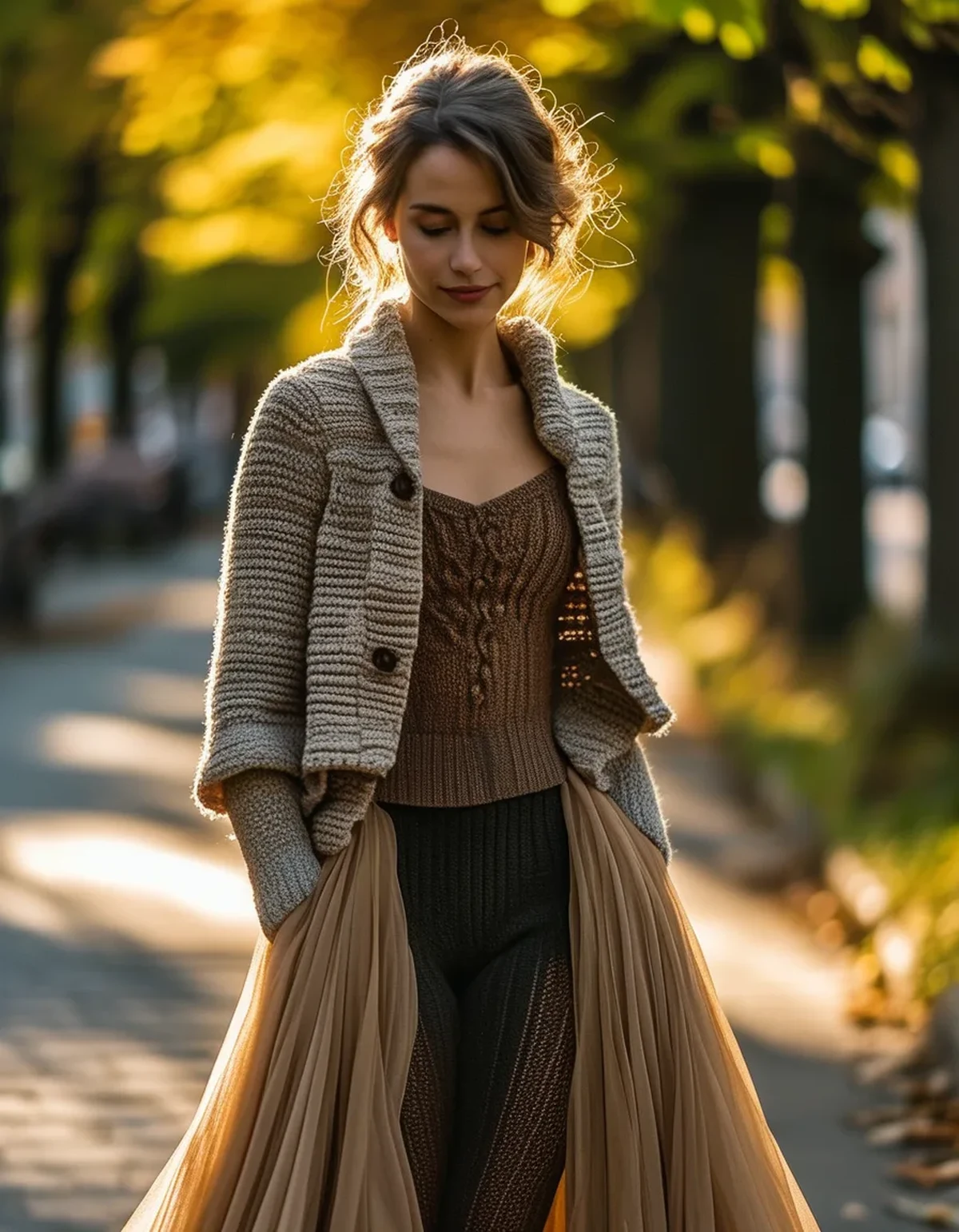
Swap one: fine knits become ribbed and chunky. Keep the wrap shape, the ballet neckline, and the defined waist, and move to a heavier gauge. A ribbed wrap cardigan in a chunky knit reads unmistakably as the same aesthetic while being a genuinely warm garment. This is the highest-value change.
Swap two: bare legs become opaque or ribbed tights. Ribbed tights in particular are strongly associated with dancewear, so they reinforce the reference rather than fighting it. Opaque tights in cream, grey, brown, or black all work; sheer tights read as formalwear rather than as balletcore.
Swap three: ballet flats become Mary Janes or flat boots. A Mary Jane with a strap keeps the ballet reference explicitly - the strap is the visual link - while offering a sturdier sole. A flat or low-heeled ankle boot works when it is genuinely cold, though it moves further from the reference.
And shift the palette warmer rather than darker. Cream, camel, chocolate brown, deep burgundy, and warm grey keep the softness while suiting autumn light. Going straight to black loses the quality that made the aesthetic appealing.
Keep the silhouette identical throughout. Defined waist, full or fluid skirt, wrapped or scooped neckline, visible ankle line. Those shapes are what identify the look, and they survive any change in fabric weight.
What Nobody Tells You About Layering Balletcore
The coat undoes everything if you choose it wrong. A structured wool coat over a soft balletcore outfit reads as two unrelated outfits. A wrap coat, a soft belted coat, or a long cardigan-style coat continues the line instead of interrupting it, and it is the piece most worth investing in for this aesthetic.
Leg warmers actually work better in autumn than in summer. They were always slightly incongruous over bare legs in July. Over tights in October they are functional, which makes them read as intentional rather than as costume - one of the few cases where the cold season improves a piece.
Texture contrast replaces color contrast. In a warm-weather palette of pale tones, the interest came from the colors being unusual. In autumn, put the interest in surface - ribbed against smooth, knit against satin, wool against silk. A cream ribbed knit with a cream satin skirt is far more interesting than the same outfit in one texture.
A slip skirt in a heavier satin survives much further into the season than people expect, particularly over opaque tights and with a chunky knit above. The combination of a heavy top and a fluid bottom is the most reliable autumn balletcore formula there is.
Watch the sock-to-shoe transition closely. Balletcore involves a lot of visible ankle, and in cold weather that becomes a sock decision. A ribbed sock scrunched at the ankle with a Mary Jane is the version that works; a thick crew sock disappearing into a boot is not.
And the costume line is real. Full pink, satin, and a bun in one outfit tips into looking like actual dancewear. One or two references land as style; four land as a costume. In autumn, letting the outerwear be plainer keeps the balance.
What does a full autumn outfit look like?
The reliable formula: chunky knit top, fluid bottom, opaque tights, Mary Jane. A ribbed wrap cardigan in cream, a satin or crepe midi skirt in chocolate or burgundy, brown opaque tights, and a black or brown Mary Jane. Tonal, textural, warm enough for a 55-degree day.
The colder-day version. Swap the Mary Jane for a flat ankle boot and add a wrap coat in camel. The leg warmers go over the tights and under the boot line.
The workday version. Chunky knit, tailored wide-leg trouser instead of a skirt, opaque sock, loafer. Keeps the neckline and the waist definition, loses the overtly dance-adjacent elements that a conservative office might not accommodate.
The weekend version. Ribbed knit dress with a defined waist, opaque tights, chunky-soled Mary Jane, long soft cardigan over the top. One piece plus tights plus a layer, and it takes ninety seconds to assemble.
Accessories to keep it in register. A ribbon in the hair reads as balletcore in any season and costs nothing. A small structured bag, a fine gold chain, minimal earrings. Keep it sparse - the aesthetic is about softness and line, not about accumulation.
And test the outfit at the door, not in the mirror. Put on the coat and look at what is actually visible. If the coat covers everything that made it balletcore, the outfit only exists indoors - and half of autumn is spent outdoors.
FAQ: Autumn Balletcore Questions, Answered
How do you wear balletcore in cold weather?
Keep the silhouette - defined waist, wrap or scoop neckline, fluid skirt - and change the fabric weight. Chunky ribbed knits instead of fine ones, opaque or ribbed tights instead of bare legs, and Mary Janes or flat boots instead of ballet flats.
What tights work with balletcore?
Ribbed or opaque tights in cream, grey, brown, or black. Ribbed ones are especially good because ribbing is itself a dancewear reference, so they reinforce the aesthetic. Sheer tights read as formalwear and pull the outfit in a different direction.
What coat goes with a balletcore outfit?
A wrap coat, a soft belted coat, or a long cardigan-style coat. A structured wool coat interrupts the soft line and makes the outfit read as two separate looks - the coat is the piece most worth getting right for this aesthetic.
How do I avoid balletcore looking like a costume?
Limit yourself to one or two explicit references rather than four. Pink plus satin plus a bun plus ribbons together reads as dancewear; a chunky ribbed wrap knit with a hair ribbon reads as style. In autumn, keeping the outerwear plain does most of that work.
TL;DR:
- Balletcore struggles in cold weather because it relies on thin knits, pale colors, bare legs, and thin-soled flats.
- Keep the silhouette and change only the weight: chunky ribbed knits, opaque or ribbed tights, Mary Janes or flat boots.
- Shift the palette warmer rather than darker - cream, camel, chocolate, burgundy - since black loses the softness.
- Put the interest in texture contrast rather than color, and pair a heavy knit top with a fluid satin bottom.
- Choose a wrap or belted coat; a structured wool coat makes the outfit read as two unrelated looks.
Check the outfit with the coat on, at the door. If nothing balletcore survives the outerwear, it only exists indoors.
Keep Reading
This article is for general informational and styling purposes only. Fit, sizing, and product availability may vary.