Balletcore Was Built for a Heated Studio — Here's How to Wear It Outside
Quick Answer: Balletcore reads as balletcore because of line — a long neck, a defined waist, a visible leg. Cold weather kills it when you add bulk that hides all three. The fix is layering with thin, dense fabrics rather than thick ones: merino under, wrap layers over, opaque tights instead of bare legs, and warmth concentrated in pieces that are already part of the vocabulary — leg warmers, wrap cardigans, and a long coat.
The look was invented indoors. Studios are heated, dancers are working, and nobody in the reference photos has ever been cold.
So the first genuinely chilly week is when balletcore either becomes a costume you don’t wear or turns into a real autumn wardrobe. It depends on four decisions.

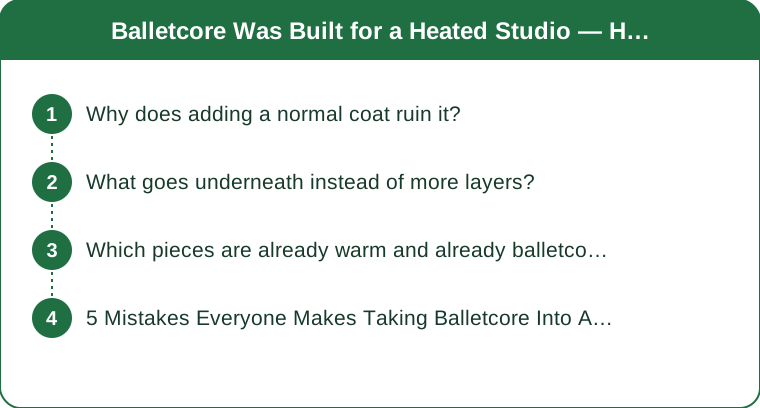
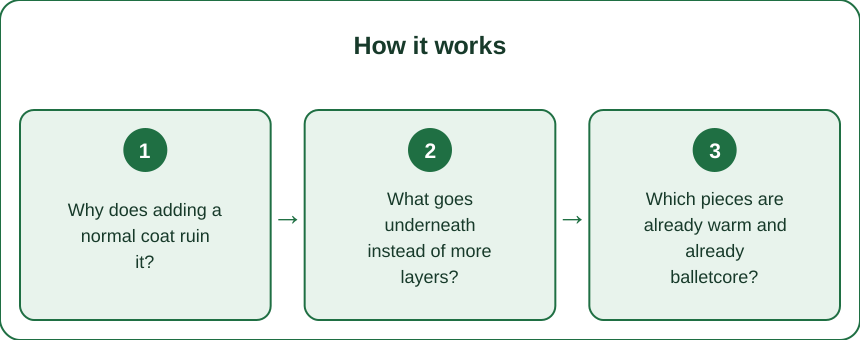
Why does adding a normal coat ruin it?
Because the aesthetic is built on three specific lines and a bulky coat erases all three at once.
The neck. Wrap tops, scoop necks, and off-shoulder pieces all exist to expose a long line from jaw to collarbone. A high-collared puffer covers it entirely.
The waist. Wrap cardigans, tied ribbons, and high-waisted bottoms create a defined midpoint. A straight-cut coat removes the definition and turns you into a rectangle.
The leg. The look depends on seeing the full line of the leg, which is why tights and fitted knits are central to it. A thick coat ending at mid-thigh cuts the leg in half at the widest point.
So the coat problem isn’t warmth — it’s geometry. Any outer layer you choose has to preserve at least two of the three, and the ones that do are quite specific: a long wrap coat that ties at the waist, a longline coat worn open over a defined waist, or a cropped structured jacket over a full-length leg line.
What almost never works: a mid-thigh puffer with a high collar. It fails all three at once.
What goes underneath instead of more layers?
This is the actual technical answer, and it’s a fabric question rather than a styling one.
The rule: thin and dense beats thick and lofty when you need to preserve a silhouette.
- Merino base layers. A 150 to 200 gsm merino long-sleeve under a wrap top adds almost no visible bulk and a genuine amount of warmth. It’s the single most useful purchase for wearing this aesthetic outdoors.
- Fleece-lined tights at 60 to 100 denier or higher. Modern brushed-interior tights are warm enough for most of autumn and still read as tights, not as leggings.
- Silk or fine-knit camisoles as a middle layer under a bodysuit or a thin knit.
- Cashmere or fine merino knits rather than chunky ones. A fine-gauge knit drapes and follows the body; a chunky one sits away from it and adds width everywhere.
What to avoid: thermal underlayers with visible texture, anything with a waffle or ribbed face that will show through a thin top, and puffy fleece of any kind. The whole strategy depends on the layers being invisible.
One practical note: layering thin pieces requires them to actually fit close. A loose base layer under a fitted top bunches, and bunching is more visible than bulk.

Which pieces are already warm and already balletcore?
Several, which is convenient, because the vocabulary was built in draughty rehearsal spaces.
Leg warmers. Not a trend accessory — a functional garment. Over tights, scrunched at the ankle or pulled to the knee, they add real warmth to the part of the leg that gets coldest while emphasizing rather than hiding the line. Wool or wool-blend rather than acrylic.
The wrap cardigan. Ties at the waist, so it adds a layer while creating the waist definition the look needs. A longer wrap in a fine knit is one of the most useful autumn pieces in this whole aesthetic.
Ballet flats with a proper sole, or the seasonal upgrade: a soft ankle boot in a neutral. Bare feet in flats stops being viable around now, and thin socks or opaque tights into a flat is the correct move rather than abandoning the shoe.
A large soft scarf. Wrapped loosely, it covers the neck when you’re outside and drapes into a vertical line when you’re not, which preserves the long line rather than cutting it.
Knit shorts or a wrap skirt over tights. A layered lower half is genuinely warmer and it’s already part of the reference vocabulary.
The pattern here: every piece that adds warmth in this aesthetic does it by wrapping or extending, never by covering.
5 Mistakes Everyone Makes Taking Balletcore Into Autumn
1. Switching to opaque black tights and stopping there. Black tights with a black top and a black cardigan is a monochrome look, not a balletcore one — the aesthetic depends on soft light neutrals and the contrast between them. Warm greys, creams, dusty pinks, and pale browns are the palette, and it’s what makes the difference between this and generic athleisure.
2. Buying chunky knits. They’re warm, they’re everywhere in autumn, and they flatten the whole silhouette. Fine gauge only.
3. Wearing the bodysuit alone outdoors. A bodysuit is a base layer in cold weather, not a top. It needs something over it, and the something should tie or wrap.
4. Forgetting the feet. The look is built around a delicate shoe, and delicate shoes are cold. Solve it deliberately with thin wool socks and a lined flat, or a soft boot in the same neutral — don’t just wear sneakers and hope the rest carries it.
5. Treating it as costume rather than proportion. The most common failure. Balletcore worn well is a set of proportion rules — high waist, long neck, defined line, soft palette — not a shopping list of ribbons and tulle. The third mistake is the one people repeat longest, because a bodysuit genuinely does feel like a top indoors and genuinely isn’t one at 52°F.
TL;DR:
- The aesthetic lives on three lines: neck, waist, leg. Any outer layer must preserve at least two.
- Layer with thin and dense — merino bases, 60–100 denier fleece-lined tights, fine-gauge knits. Never chunky.
- The pieces that were always both warm and correct: leg warmers, wrap cardigans, big soft scarves, layered skirts over tights.
- Keep the soft neutral palette. All-black is a different look entirely.
- Solve the shoes deliberately — thin wool socks in a lined flat, or a soft neutral ankle boot.
Everything that adds warmth here should wrap or extend. Nothing should cover.
Keep Reading
This article is for general informational and styling purposes only. Fit, sizing, and product availability may vary.